Palmer Frederick
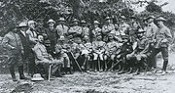
Frederick Palmer (Jan 29, 1873 - Sep 2, 1958) was an American journalist and writer. He was born in Pleasantville, Pennsylvania. He attended Allegheny College in Meadville, Pennsylvania.[1] The New York Press hired Palmer in 1895 as its London correspondent; and this opportunity evolved into a long career.[1] Palmer's fifty years as a war correspondent began when he was sent to cover the Greco-Turkish War of 1897 for the New York World and for Collier's Weekly. He then covered the gold rush in northwestern Canada. The Philippine–American War (1899-1902) provided an opportunity for him to cross the Pacific bound for Manilla.[1] In 1900, Palmer went to China to cover the Boxer Rebellion (1900); and then he was sent to cover the Boer War (1899-1902) in South Africa.[1] Then the prospect of military conflict in Manchuria brought him back to China to cover the Russo-Japanese War (1904-1905) for the New York Globe.[2]. The New York Times sent him to cover the Balkan War in 1912.[1] In 1914, he was arrested in Mexico City while covering the Tampico Affair (1914) and the United States occupation of Veracruz for Everybody's Magazine.[1] General John Pershing persuaded him to take on the task of press accreditation for the American Expeditionary Force (AEF). In this period, he was accorded the rank of Colonel.[1]
do you like this author?
What readers are saying
What do you think? Write your own comment on this book!
write a commentWhat readers are saying
What do you think? Write your own comment on this author!
write a commentBook list

My Year of the WarIncluding an Account of Experiences with the Troops in France andthe Record of a Visit to the Grand Fleet Which is Here Given for theFirst Time in its Complete Form
Series:
Unknown
Year:
Unknown
Raiting:
3.5/5
Show more
add to favoritesadd In favorites
add to favoritesadd In favorites
Book list
My Year of the WarIncluding an Account of Experiences with the Troops in France andthe Record of a Visit to the Grand Fleet Which is Here Given for theFirst Time in its Complete Form
Series:
Unknown
Year:
Unknown
Raiting:
3.5/5
Show more
add to favoritesadd In favorites
add to favoritesadd In favorites

with kuroki in manchuria
Series:
Unknown
Year:
Unknown
Raiting:
5/5
Purchase of this book includes free trial access to www.million-books.com where you can read more than a million books for free. This is an OCR edition with typos. Excerpt from book: m THE NIGHT OF VICTORY Yesterday the Japanese lanterns were telescoped; to-night they are alight; to-night Tokio hears only of victory. All day the men who sell the extras have been hurrying through the streets, their cries drowning the decorous tinkle of their little bells. Bulletins, the size of a sheet of note- paper, have been sweetmeats to the public, whose stomach could not have surfeit of such news. This we do know: The cruiser Variag and the gunboat Korietz are wrecks at Chemulpo, and Admiral Togo has dealt a telling blow at Port Arthur. Much more we hope, wanting to believe every happy rumor that ink makes on paper and sends broadcast with clarion voiceprice, one sen. The Japanese does not cheer until he has won. To-night the population of the town seems twenty times what it was the night war began. Tokio, having something to be proud of, opens its doors and shows its head. The little Buddhist images, withfar-off, subtle smiles, wake up and blink. The paper-windowed houses that husbanded doubts and fears and the tense expectancy of a people who think of their Emperor's fortune before their own, send their occupants forth, if not to merry-making at least to walk up and down. Streets that were dark last night dance with globes of yellow light to-night. The Japanese lantern does not belong in a land where you read from left to right horizontally, but to a land where you read from right to left perpendicularly. The lantern goes with the people, their houses, their costume, and their manners. You must come to Japan to understand the lantern; you must be in Tokio on the night of victory to realize that it is a living thing. In columns of twos and threes?? ill-lighted city serving a pictorial endwinding in and out through the streets ran the yellow balls of ...
Show more
add to favoritesadd In favorites

the ways of the service
Series:
Unknown
Year:
Unknown
Raiting:
5/5
Originally published in 1901. This volume from the Cornell University Library's print collections was scanned on an APT BookScan and converted to JPG 2000 format by Kirtas Technologies. All titles scanned cover to cover and pages may include marks notations and other marginalia present in the original volume.
Show more
add to favoritesadd In favorites

the vagabond
Series:
Unknown
Year:
Unknown
Raiting:
4/5
Purchase of this book includes free trial access to www.million-books.com where you can read more than a million books for free. This is an OCR edition with typos. Excerpt from book: Ill AND FOUB PBOVE ENOUGH Oh, you foolish adults with work-stiffened imaginations ! Between trips to the house of death, Mrs. Hawkins warned the "poor dear" not to cry, for his pa had only gone to sleep. In truth, Billy had not shed a tear, a fever of wonder, awe, and agony having dried the ducts. With his knees on the rag-carpet cushion of a cane chair, he watched the coroner's jury congregate, one by one, proceed in a body to their duties, and one by one depart. Then came the undertaker from Wewland Centre and the inquiring neighbors, with "do tells." Half hidden behind the curtains he heard their greetings and speculations. They "wondered" what would become of the boy; they had "hearn tell" that Williams had "perty much" run through everything he had, and what he hadn'ta witticism this, in a knowing whisperJim Hawkins had got; they "guessed" that the outlook for the "little shaver" was "perty bad" and he'd have to be "bound out" to somebody for his "keep." That is, "onless" Judge John Williams, of the neighboring county, should take a hand. But the Judge had never had any association with his brother. A "curyus" man, said a Whig. There politics was interjected. "Curyus!" exclaimed a Democrat, in sarcasm. "D'ye ever hear him speak ? He wiped out twentysix hundred Whig majority in Belmore, that's what he did. He's the youngest jedge Belmore ever had. Curyus! He's jest curyus 'nough to be Governor of this State some day." Even while they discussed this rising statesman, a mud-bespattered buggy from the Newland Centre livery-stable drove up. "That's a good mare you've got, Ed," said the passenger, as he alighted, as if he had known the driver all his life instead of two hours. "How're ye, Jedge ?" said his defender, his waist receding and his chest swelling. ... --This text refers to an alternate Paperback edition.
Show more
add to favoritesadd In favorites

the folly of nations
Series:
Unknown
Year:
Unknown
Raiting:
4/5
This volume is produced from digital images created through the University of Michigan University Library's large-scale digitization efforts. The Library seeks to preserve the intellectual content of items in a manner that facilitates and promotes a variety of uses. The digital reformatting process results in an electronic version of the original text that can be both accessed online and used to create new print copies. The Library also understands and values the usefulness of print and makes reprints available to the public whenever possible. This book and hundreds of thousands of others can be found in the HathiTrust, an archive of the digitized collections of many great research libraries. For access to the University of Michigan Library's digital collections, please see http://www.lib.umich.edu and for information about the HathiTrust, please visit http://www.hathitrust.org
Show more
add to favoritesadd In favorites

the big fellow
Series:
Unknown
Year:
Unknown
Raiting:
5/5
This scarce antiquarian book is included in our special Legacy Reprint Series. In the interest of creating a more extensive selection of rare historical book reprints, we have chosen to reproduce this title even though it may possibly have occasional imperfections such as missing and blurred pages, missing text, poor pictures, markings, dark backgrounds and other reproduction issues beyond our control. Because this work is culturally important, we have made it available as a part of our commitment to protecting, preserving and promoting the world's literature.
Show more
add to favoritesadd In favorites
palmer plan handbook photoplay writing simplified and explained
Series:
Unknown
Year:
Unknown
Raiting:
5/5
Show more
add to favoritesadd In favorites
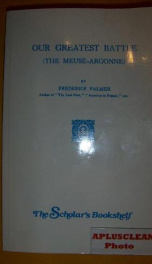
our greatest battle the meuse argonne
Series:
Unknown
Year:
Unknown
Raiting:
4/5
Our Greatest Battle (The Meuse-Argonne) was published for the first time immediately after World War I. The book belongs to the pen of an American soldier and later press officer Frederick Palmer. This particular story is devoted to the events of the battle near The Meuse-Argonne. Of course, the book is quite subjective, it includes mainly author's observations during this operation. Frederick Palmer analyzes the steps made bu American divisions, their strategies and operations, battle planning and executing, and, of course, personal impressions from the point of view of an ordinary American soldier. The book is definitely recommended to all readers who are interested in the account of events of World War I and the battle near The Meuse-Argonne.
Show more
add to favoritesadd In favorites

lucy of the stars
Series:
Unknown
Year:
Unknown
Raiting:
5/5
This volume is produced from digital images created through the University of Michigan University Library's preservation reformatting program. The Library seeks to preserve the intellectual content of items in a manner that facilitates and promotes a variety of uses. The digital reformatting process results in an electronic version of the text that can both be accessed online and used to create new print copies. This book and thousands of others can be found in the digital collections of the University of Michigan Library. The University Library also understands and values the utility of print, and makes reprints available through its Scholarly Publishing Office.
Show more
add to favoritesadd In favorites
add to favoritesadd In favorites
add to favoritesadd In favorites
add to favoritesadd In favorites
add to favoritesadd In favorites

america in france
Series:
Unknown
Year:
Unknown
Raiting:
5/5
This book describes the story of American army in France during World War I. The story was published in 1918 immediately after the end of the war. The author does a great job analyzing the main strategies of the American army and the events that led to the victory. America in France is a real find for those readers who like history and are especially interested in the period of World War I.
Show more
add to favoritesadd In favorites
Over the Pass
Series:
Unknown
Year:
Unknown
Raiting:
4.5/5
Here time was as nothing; here sunset and sunrise were as incidents of an uncalendared everlasting day; here chaotic grandeur was that of the earth's crust when it cooled after the last convulsive movement of genesis. --This text refers to an alternate Hardcover edition.
Show more
add to favoritesadd In favorites
What readers are saying
What do you think? Write your own comment on this author!
write a commentif you like Palmer Frederick try:
readers also enjoyed
What readers are saying
What do you think? Write your own comment on this author!
write a commentGenre
if you like Palmer Frederick try:
readers also enjoyed
Do you want to read a book that interests you? It’s EASY!
Create an account and send a request for reading to other users on the Webpage of the book!

