Gilbert William Schwenck
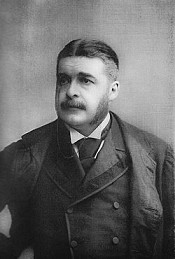
Sir Arthur Seymour Sullivan MVO (13 May 1842 – 22 November 1900) was an English composer, of Irish and Italian descent, best known for his operatic collaborations with librettist W. S. Gilbert, including such continually-popular works as H.M.S. Pinafore, The Pirates of Penzance, and The Mikado. Sullivan's artistic output included 23 operas, 13 major orchestral works, eight choral works and oratorios, two ballets, incidental music to several plays, and numerous hymns and other church pieces, songs, parlour ballads, part songs, carols, and piano and chamber pieces. Apart from his comic operas with Gilbert, Sullivan is best known for some of his hymns and parlour songs, including "Onward Christian Soldiers", "The Absent-Minded Beggar", and "The Lost Chord". His most critically-praised pieces include his Irish Symphony, his Overture di Ballo, The Martyr of Antioch, The Golden Legend, and, of the Savoy Operas, The Yeomen of the Guard. Sullivan's only grand opera, Ivanhoe, was initially highly successful, but it has been little heard since his death. Sullivan was born in Lambeth, London.[1] His father, Thomas Sullivan (1805–1866), was a military bandmaster and music teacher born in Ireland, who was educated in Chelsea, London and was based for some years at the Royal Military Academy Sandhurst.[2] Here Arthur became proficient with all the instruments in the band by the age of eight.[3] His mother Mary Clementina (née Coghlan, 1811–1882) was English, of Irish and Italian descent.[4][2] While studying at a private school in Bayswater, Sullivan convinced his parents and the headmaster, William Gordon Plees, to allow him to try out for the choir of the Chapel Royal. Despite concerns about Sullivan's age, which would limit how long he could serve before his voice began to change, he was accepted and soon became a soloist.[5] Sullivan flourished under the training of Reverend Thomas Helmore, the master of the choristers, and began to compose anthems and songs.[6] Helmore arranged for one of these, "O Israel", to be published by Novello in 1855 – Sullivan's first published work. Helmore also enlisted Sullivan's assistance in creating harmonisations for a volume of The Hymnal Noted.[7] In 1856, the Royal Academy of Music awarded the first Mendelssohn Scholarship to the fourteen-year-old Sullivan, granting him a year's training at the academy.[8][9][10] This was extended to a second year at the academy, and in 1858 the scholarship committee, in an "extraordinary gesture of confidence",[11] extended it for a third year so that he could study in Leipzig, Germany, at the Leipzig Conservatoire.[11] While there, Sullivan was trained in Mendelssohn's ideas and techniques but was also exposed to a variety of new musical styles, including Schubert, Verdi, Bach and Wagner.[12] Visiting a Jewish synagogue, he was so struck by some of the cadences and progressions of the music that thirty years later he would still remember it vividly enough to use them in his grand opera, Ivanhoe.[12] He also developed various acquaintances and friendships at Leipzig, such as Carl Rosa, who was later to create the Carl Rosa Opera Company; violinist Joseph Joachim, and composer Franz Liszt.[13] For his last year at the Conservatoire, money was scraped together by his father, and the Conservatoire assisted by waiving its fees.[14] Sullivan credited his Leipzig period with tremendous musical growth. His graduation piece, completed in 1861, was a set of incidental music to Shakespeare's The Tempest.[12] Revised and expanded, it was performed at the Crystal Palace in 1862, a year after his return to London, and was an immediate sensation. He began building a reputation as England's most promising young composer.[15] Sullivan's early major works were those typically expected of a serious composer. In 1866, he premiered the Irish Symphony (though he may have completed it by 1863) and the Concerto for Cello and Orchestra, his only works in each genre.[16] In the same year, his Overture in C (In Memoriam), written in grief shortly after the death of his father, was a commission from the Norwich Festival, and during his lifetime it was one of his most successful works for orchestra.[17] His single most successful orchestral work,[18] the Overture di Ballo, satisfied a commission from the Birmingham Festival in 1870.[19] His long association with works for the voice began early. Significant commissions for chorus and orchestra included The Masque at Kenilworth (Birmingham Festival, 1864);[20] an oratorio, The Prodigal Son (Three Choirs Festival, 1869);[21] a dramatic cantata, On Shore and Sea (Opening of the London International Exhibition, 1871);[22] the Festival Te Deum (Crystal Palace, 1872);[23] and another oratorio, The Light of the World (Birmingham Festival, 1873).[23] His only song cycle was also written in this period: The Window; or, The Songs of the Wrens (1871), in collaboration with Tennyson.[24] Sullivan's affinity for theatrical works also began early. During a stint as organist at Covent Garden, he composed his first ballet, L'Île Enchantée (1864), and had his first experience of opera, which was directed there by Sir Michael Costa.[25] In the nineteenth century, plays were often accompanied by live incidental music, and Sullivan composed music for more than half a dozen productions. Early examples included The Merchant of Venice (Prince's Theatre, Manchester, 1871);[26] The Merry Wives of Windsor (Gaiety Theatre, London, 1874);[27] and Henry VIII (Theatre Royal, Manchester, 1877).[28] His earlier Tempest incidental music, although composed with the theatre in mind, was originally prepared for the concert hall.[29] He would continue in this genre throughout his life, with incidental music to Macbeth (1888) at the Lyceum Theatre;[30] to Alfred Tennyson's The Foresters (1892) Daly's Theatre in New York; and to J. Comyns Carr's King Arthur (1895), again at the Lyceum.[31] These commissions were not sufficient to keep Sullivan afloat.[32] He worked as a church organist from 1861 to 1872,[33] gave singing and piano lessons, and composed some 72 hymns, most of them in the period 1861–75. The most famous of these are "Onward, Christian Soldiers" (1872, words by Sabine Baring-Gould) and "Nearer, my God, to Thee" (the "Propior Deo" version).[34] He also turned out over 80 popular songs and parlour ballads – again, most of them written before the late 1870s.[35] His first popular song was "Orpheus with his Lute", and a popular part song was "Oh! hush thee, my babie."[7] The best known of his songs is "The Lost Chord" (1877, lyrics by Adelaide Anne Procter), written in sorrow at the death of his brother Fred, who had created the roles of Apollo in Thespis and The Learned Judge in Trial by Jury.[32] In the autumn of 1867, he travelled with George Grove to Vienna, returning with a treasure-trove of rescued Schubert scores, including the music to Rosamunde.[36] Sullivan's first attempt at opera, The Sapphire Necklace (1863–64, libretto by Henry F. Chorley), was not produced and is now lost, although the overture and two songs from the work were separately published.[37] His first surviving opera, Cox and Box (1866), was originally written for a private performance.[32] It then received charity performances in both London and Manchester, and it was later produced at the Gallery of Illustration, where it ran for an extremely successful 264 performances. A freelance journalist named W. S. Gilbert, writing on behalf of a humour magazine called Fun, pronounced the score superior to F. C. Burnand's libretto.[38] The first Sullivan-Burnand collaboration was sufficiently successful to spawn a two-act opera, The Contrabandista (1867; revised and expanded as The Chieftain in 1894), which did not achieve great popularity.[39] In 1873, Sullivan contributed two songs to Burnand's Christmas "drawing room extravaganza", The Miller and His Man.[40] In 1871, John Hollingshead commissioned Sullivan to work with W. S. Gilbert to create the burlesque Thespis for the Gaiety Theatre. Conceived specifically as a Christmas entertainment, it ran through to Easter 1872. The work was produced rather quickly, after which Gilbert and Sullivan went their separate ways,[41] with the exception of two parlour ballads in late 1874 and early 1875.[42] In 1875, theatre manager Richard D'Oyly Carte needed a short piece to fill out a bill with Offenbach's La Périchole for the Royalty Theatre. Remembering Thespis, Carte reunited Gilbert and Sullivan, and the result was the one-act comic opera Trial by Jury. The success of this piece launched Gilbert and Sullivan on their famous partnership, which produced an additional twelve comic operas.[43] However, Sullivan was not yet exclusively hitched to Gilbert. Soon after the successful opening of Trial, Sullivan wrote The Zoo, another one-act comic opera, with a libretto by B. C. Stephenson.[44] But the new work had only a few short runs, and Sullivan collaborated on operas only with Gilbert for the next 15 years. Sullivan's next opera with Gilbert, The Sorcerer (1877), was a success by the standards of the day,[45] but H.M.S. Pinafore (1878), which followed it, turned Gilbert and Sullivan into an international phenomenon.[46] Indeed, Pinafore was so successful that over a hundred unauthorised productions sprang up in America alone. Gilbert, Sullivan and Carte tried for many years to control the American performance copyrights over their operas, without success.[47] Pinafore was followed by another hit, The Pirates of Penzance in (1879), and then Patience (1881). Later in 1881, Patience transferred to the new Savoy Theatre, where the remaining Gilbert and Sullivan joint works were produced, as a result of which they are commonly known as the "Savoy Operas".[48] Iolanthe (1882) was the first of their works to premiere at the new theatre.[49] On 22 May 1883, during the run of Iolanthe, Sullivan was knighted by Queen Victoria at Windsor Castle.[50] The announcement of this impending honour was made just before Sullivan's 40th birthday at the opening of the Royal College of Music.[51] Although it was the operas with Gilbert that had earned him the broadest fame, the honour was conferred for his services to serious music.[48] The musical establishment, and many critics, believed that this should put an end to his career as a composer of comic opera — that a musical knight should not stoop below oratorio or grand opera.[52] Sullivan too, despite the financial security of writing for the Savoy, increasingly viewed his work with Gilbert as unimportant, beneath his skills, and also repetitious. Furthermore, he was unhappy that he had to simplify his music to ensure that Gilbert's words could be heard. But paradoxically, only two months before receiving news of the honour, Sullivan had signed a five-year agreement with Gilbert and Carte, compelling him to produce a new comic opera on six months' notice.[53] Having agreed to this, Sullivan suddenly felt trapped.[54]

Do you want to read a book that interests you? It’s EASY!
Create an account and send a request for reading to other users on the Webpage of the book!

