want book
© OnRead.com
subscription title
buy
Categories


Home

Wilcox Ella Wheeler

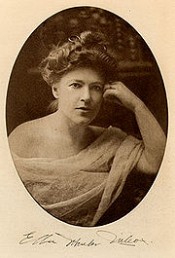
Ella Wheeler Wilcox (November 5, 1850–October 30, 1919) was an American author and poet. Her best-known work was Poems of Passion. Her most enduring work was "Solitude", which contains the lines: "Laugh, and the world laughs with you; Weep, and you weep alone". Her autobiography, The Worlds and I, was published in 1918, a year before her death. Ella Wheeler was born in 1850 on a farm in rural Johnstown, Wisconsin, east of Janesville, the youngest of four children. The family soon moved to north of Madison. She started writing poetry at a very early age, and was well known as a poet in her own state by the time she graduated from high school. When about 28 years of age, she married Robert Wilcox. They had one child, a son, who died shortly after birth. Not long after their marriage, they both became interested in Theosophy, New Thought, and Spiritualism. Early in their married life, they promised each other that whoever went first through death would return and communicate with the other. Robert Wilcox died in 1916, after over thirty years of marriage. She was overcome with grief, which became ever more intense as week after week went without any message from him. It was at this time that she went to California to see the Rosicrucian astrologer Max Heindel, still seeking help in her sorrow, still unable to understand why she had had no word from her Robert. This is how she tells of this meeting: "In talking with Max Heindel, the leader of the Rosicrucian Philosophy in California, he made very clear to me the effect of intense grief. Mr. Heindel assured me that I would come in touch with the spirit of my husband when I learned to control my sorrow. I replied that it seemed strange to me that an omnipotent God could not send a flash of his light into a suffering soul to bring its conviction when most needed. Did you ever stand beside a clear pool of water, asked Mr. Heindel, and see the trees and skies repeated therein? And did you ever cast a stone into that pool and see it clouded and turmoiled, so it gave no reflection? Yet the skies and trees were waiting above to be reflected when the waters grew calm. So God and your husband's spirit wait to show themselves to you when the turbulence of sorrow is quieted". Several months later, she composed a little mantra or affirmative prayer which she said over and over "I am the living witness: The dead live: And they speak through us and to us: And I am the voice that gives this glorious truth to the suffering world: I am ready, God: I am ready, Christ: I am ready, Robert.". Wilcox made efforts to teach occult things to the world. Her works, filled with positivism, were popular in the New Thought Movement and by 1915 her booklet, What I Know About New Thought had a distribution of 50,000 copies, according to its publisher, Elizabeth Towne. The following statement expresses Wilcox's unique blending of New Thought, Spiritualism, and a Theosophical belief in reincarnation: "As we think, act, and live here today, we built the structures of our homes in spirit realms after we leave earth, and we build karma for future lives, thousands of years to come, on this earth or other planets. Life will assume new dignity, and labor new interest for us, when we come to the knowledge that death is but a continuation of life and labor, in higher planes". A popular poet rather than a literary poet, in her poems she expresses sentiments of cheer and optimism in plainly written, rhyming verse. Her world view is expressed in the title of her poem "Whatever Is—Is Best", suggesting an echo of Alexander Pope's "Whatever is, is right." None of Wilcox's works were included by F. O. Matthiessen in The Oxford Book of American Verse, but Hazel Felleman chose no fewer than thirteen of her poems for Best Loved Poems of the American People, while Martin Gardner selected "Solitude" and "The Winds of Fate" for Best Remembered Poems. She is frequently cited in anthologies of bad poetry, such as The Stuffed Owl: An Anthology of Bad Verse and Very Bad Poetry. Sinclair Lewis indicates Babbitt's lack of literary sophistication by having him refer to a piece of verse as "one of the classic poems, like 'If' by Kipling, or Ella Wheeler Wilcox's 'The Man Worth While.'" The latter opens: Her most famous lines open her poem "Solitude": "The Winds of Fate" is a marvel of economy, far too short to summarize. In full: Her quote "Love lights more fires than hate extinguishes" is inscribed on a paving slab in Jack Kerouac Alley in San Francisco (next to the City Lights Bookstore). "Solitude" was first published in the February 25, 1883 issue of The New York Sun. The inspiration for the poem came as she was travelling to attend the Governor's inaugural ball in Madison, Wisconsin. On her way to the celebration, there was a young woman dressed in black sitting across the aisle from her. The woman was crying. Miss Wheeler sat next to her and sought to comfort her for the rest of the journey. When they arrived, the poet was so depressed that she could barely attend the scheduled festivities. As she looked at her own radiant face in the mirror, she suddenly recalled the sorrowful widow. It was at that moment that she wrote the opening lines of "Solitude": She sent the poem to the Sun and received $5 for her effort. In May 1883, "Solitude" appeared in Wheeler's book, Poems of Passion. Her final words in her autobiography The Worlds and I: "From this mighty storehouse (of God, and the hierarchies of Spiritual Beings ) we may gather wisdom and knowledge, and receive light and power, as we pass through this preparatory room of earth, which is only one of the innumerable mansions in our Father's house. Think on these things". Ella Wheeler Wilcox died of cancer in 1919, a week before her 69th birthday. Ella Wheeler Wilcox's name provided the unlikely inspiration for doggerel by the English humorist Richard Murdoch, which he set to the opening bars of Alexandre Luigini's Ballet egyptien.


1-10 results of 21

The Heart of the New Thought

The main ideas of Ella Wheeler Wilcox's book are rather simple. But one shouldn't underestimate the meaning of her style. This is a "thought" about a young man, who is learning secrets of a wonderful mythical science - alchemy, which helps to transform stones into gold. It is a metaphor - the author wants to say that if we look in our own soul, we will discover just an enormous fount of strong spirit, will and power - one just should be able to see and develop it. If you are lucky enough to cope with them - you will take the treasure any alchemist ever had.
Ms. Wilcox explains why we need to work over our mind, our thoughts and how we are able to get the desirable thing. She shows how after a serious work on it one would be able to rather effectively and simply hurt, heal, conceal, using the facets of the human mind. The simplicity with which she narrates shouldn't confuse you, as every word she uses with definite purpose and deliberately.
The book can be considered as a perfect companion. It is simple, fair and wise. It is like a close friend who is able to touch your heart and it teaches us to be ourselves instead of pretending someone else. Withal the book can be regarded as a sincere conversation with a man who can give an advice, who has a wisdom to share with. That's why it is not amazing that one would turn to this masterpiece again and again and may be held it near to have an opportunity to reread it once more.
Ms. Wilcox experiences us, in the same time she shows the edges of our individuality, bringing it to the surface; simultaneously mocking at our light-mindedness and opening our potential Power and strength of Spirit. So, she gets an incredible effect playing on contrasts.
Ernest Holmes used her studies while working on his Science of Mind Philosophy. May be well-known motto comes it - change your thinking, change your life!
Anyway it is that sort of things one should think over!

Download: txt fb2 rtf pdf epub pdb

Three Women

This is a wise and fabulous story about love, passion and intrigue. Ella Wheeler Wilcox was at the height of her literary career. She still makes the same impression of a strong woman as she did a hundred years ago. Every page of her books still amazes readers. If you like stories in the style of Jane Austen, then you will definitely enjoy reading ‘Three women’!
In this book, Wilcox tells about a rich young man named Maurice Somerville, who comes to visit an old college friend, Roger Reese where he lives with his sister Ruth. Maurice falls in love, not with his friend’s sister Ruth, but with Mabel Lee, a neighbor. The things get more complicated with the fact that Roger is also in love with Mabel. Thus begins the incredible love story, full of difficulties, jealousy and passion.

Download: txt fb2 rtf pdf epub pdb

men women and emotions

By Ella Wheeler Wilcox, an American author and poet of the 19th-20th centuries, her first work being published at the age of 14.
With her beautiful prose sketches, collected in “Men, Women and Emotions”, she explains just what women and men want

Download: txt fb2 rtf pdf epub pdb

Poems of Power

A classic poetry by Ella Wheeler Wilcox, a journalist and popular American poet of the nineteenth and early twentieth centuries.

Download: txt fb2 rtf pdf epub pdb mobi

Custer, and Other Poems.

A collection of verse by an American author and poet of the nineteenth and early twentieth centuries, Ella Wheeler Wilcox. Published in 1896.

Download: txt fb2 rtf pdf epub pdb

The Kingdom of Love

By an American author and poet of the nineteenth and early twentieth centuries, Ella Wheeler Wilcox. The volume contains over sixty poems, including Wilcox’s famous “Solitude”.

Download: txt fb2 rtf pdf epub pdb

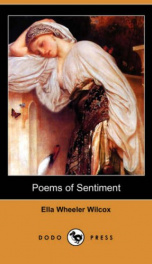
Poems of Sentiment

A classic poetry by Ella Wheeler Wilcox, a journalist and popular American poet of the nineteenth and early twentieth centuries. “Poems of Sentiment” is a romantic collection, published in 1910, that includes An Erring Woman's Love, Love's Supremacy, and Little White Hearse and many others of her daily poems for a syndicate of newspapers.

Download: txt fb2 rtf pdf epub pdb

An Ambitious Man

Preston Cheney turned as he ran down the steps of a handsome house on "The Boulevard," waving a second adieu to a young woman framed between the lace curtains of the window. Then he hurried down the street and out of view. The young woman watched him with a gleam of satisfaction in her pale blue eyes.
A mystical novel from an American author and poet of the nineteenth and early twentieth centuries, Ella Wheeler Wilcox.

Download: txt fb2 rtf pdf epub pdb

an erring womans love

Purchase of this book includes free trial access to www.million-books.com where you can read more than a million books for free. This is an OCR edition with typos. Excerpt from book: WHEN BABY SOULS SAIL OUT. When from our mortal vision Grown men and women go, To sail strange fields Elysian And know what spirits know, I think of them as tourists, In some sun-gilded clime, 'Mong happy sights and dear delights We all shall find, in time. But when a child goes yonder And leaves its mother here, Its little feet must wander, It seems to me, in fear. What paths of Eden beauty What scenes of peace and rest Can bring content to one who went Forth from a mother's breast. 40 When Baby Souls Sail Out. In palace gardens, lonely, A little child will roam, And weep for pleasures only Found in its humble home— It is not won by splendor, Nor bought by costly toys, To hide from harm on mother's arm Makes all its sum of joys. It must be when the baby Goes journeying off alone, Some angel (Mary may be), Adopts it for her own. Yet when a child is taken Whose mother stays below With weeping eyes, through Paradises I seem to see it go. With troops of angels trying To drive away its fear, I seem to hear it crying When Baby Souls Sail Out. 41 " I want my mamma here." I do not court the fancy, It is not based on doubt, It is a thought that comes unsought When baby souls sail out. AN ODE TO TIME. Ho! sportsman 'lime, whose chargers fleet The moments, madly driven, Beat in the dust beneath their feet Sweet hopes that years have given ; Turn, turn aside those reckless steeds, Oh ! do not urge them my way; There's nothing that Time wants or needs In this contented by-way. You have down-trodden, in your race, So much that proves your power, Why not avoid my humble place, Why rob me of my dower ? With your vast cellars, cavern deep, Packed tier on tier with treasures, You would not miss ...

Download: txt fb2 rtf pdf epub pdb mobi

Poems of Purpose

Ella Wheeler Wilcox (1850-1919) was an American author and poet. Her best-known work was Poems of Passion (1883), and her autobiography, The Worlds and I was published in 1918 shortly before her death. She started writing poetry at a very early age, and was well known as a poet in her own state by the time she graduated from high school. She married Robert Wilcox. Not long after their marriage, they both became interested in Theosophy, New Thought, and Spiritualism. She made efforts to teach occult things to the world. Her works, filled with positivism, were popular in the New Thought Movement and by 1915 her booklet, What I Know About New Thought had a distribution of 50,000 copies, according to its publisher, Elizabeth Towne.

Download: txt fb2 rtf pdf epub pdb mobi
1 page of 3 pages