Vitruvius Pollio
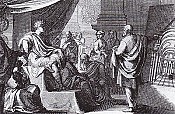
Marcus Vitruvius Pollio; Vitruvii; (born c. 80–70 BC, died after c. 15 BC) was a Roman writer, architect and engineer (possibly praefectus fabrum during military service or praefect architectus armamentarius of the apparitor status group), active in the 1st century BC. By his own description[1] Vitruvius served as a Ballista (artilleryman), the third class of arms in the military offices. He likely served as chief of the ballista (senior officer of artillery) in charge of doctores ballistarum (artillery experts) and libratores who actually operated the machines.[2] He has been called by some 'the world's first known engineer'.[3] Little is known about Vitruvius' life. His first name Marcus and his cognomen Pollio are uncertain. Cetius Faventinus speaks of "Vitruvius Polio aliique auctores" in his epitome; it is possible that the cognomen derives from this mention by Cetius, meaning Vitruvius, Polio, and others. Most inferences about his life are extracted from his only surviving work De Architectura, though he appears to be known to Pliny the Elder through his description of constructing mosaics [4] in Naturalis Historia, he is not actually named. Frontinus, however, refers to "Vitruvius the architect" in his late 1st century work On Aqueducts (1.25) Likely born a free Roman citizen, by his own account Vitruvius served the Roman army under Julius Caesar with the otherwise unknown Marcus Aurelius, Publius Minidius, and Gnaeus Cornelius. These names vary depending on the edition of De architectura. Publius Minidius is also written as Publius Numidicus and Publius Numidius, speculated to be the same Publius Numisius inscribed on the Theatre of Heraclea[5]. As an army engineer he specialized in the construction of ballista and scorpio artillery war machines for sieges. It has been speculated that Vitruvius served with Julius Caesar's Chief Engineer Lucius Cornelius Balbus[6] The locations where he served can be reconstructed from, for example, descriptions of the building methods of various "foreign tribes". Although he describes places throughout De Architectura, he does not say he was present. His service likely included north Africa, Hispania, Gaul (including Aquitaine) and Pontus. To place the role of Vitruvius the military engineer in context, a description of The Praefect of the camp or army engineer is quoted here as given by Flavius Vegetius Renatus in The Military Institutions of the Romans: At various locations described by Vitruvius, battles and sieges occurred. Of the battlegrounds of the Gallic War there is reference to the siege of Avaricum 52 BC, the Battle of Gergovia 52 BC, the Battle of Alesia 52 BC, and the siege of Uxellodunum 51 BC (all centred on sieges of large Gallic oppida). Of sites involved in Caesar's civil war, we find the Siege of Massilia 49BC,[8] the Battle of Dyrrhachium of 48 BC (Albania), the Battle of Pharsalus 48 BC (Greece), the Battle of Zela of 47 BC (Turkey) and the Battle of Thapsus 46 BC in Caesar's African campaign.[9] A legion that fits the same sequence of locations is the Legio VI Ferrata, of which ballista would be an auxilia unit. During this same time period a Roman military officer Mamurra also served as praefectus fabrum in Hispania, Gaul and Pontus under Julius Caesar. Some have suggested that these two men may be the same, though there is no mention of Caesar's invasions of Britain in De Architectura, nor of other things with which Mamurra was associated, equestrian military practices and personal wealth. Additionally Caesar appears to have outlived Mamurra, whereas Vitruvius dedicated De Architectura to the emperor Augustus. In later years the emperor Augustus, through his sister Octavia Minor, sponsored Vitruvius, entitling him with what may have been a pension to guarantee financial independence.[1] Mainly known for his writings, Vitruvius was himself an architect. In Roman times architecture was a broader subject than at present including the modern fields of architecture, construction management, construction engineering, chemical engineering, civil engineering, materials engineering, mechanical engineering, military engineering and urban planning.[10]Frontinus mentions him in connection with the standard sizes of pipes.[11] The only building, however, that we know Vitruvius to have worked on is one he tells us about,[12] a basilica completed in 19 BC.[13] It was built at Fanum Fortunae, now the modern town of Fano. The Basilica di Fano (to give the building its Italian name) has disappeared so completely that its very site is a matter of conjecture, although various attempts have been to visualise it.[14] The early Christian practice of converting Roman basilica (public buildings) into cathedrals implies the basilica may be incorporated into the cathedral located in Fano. The date of his death is unknown. Vitruvius is the author of De architectura, known today as The Ten Books on Architecture,[15] a treatise written of Latin and Greek on architecture, dedicated to the emperor Augustus. In the preface of Book I, Vitruvius dedicates his writings so to give personal knowledge of the quality of buildings to the emperor. Likely Vitruvius is referring to Marcus Agrippa's campaign of public repairs and improvements. This work is the only surviving major book on architecture from classical antiquity. This text "influenced deeply from the Early Renaissance onwards artists, thinkers, and architects, among them Leon Battista Alberti (1404-72), Leonardo Da Vinci (1452-1519), and Michelangelo (1475-1564)." [16] The next major book on architecture, Alberti's reformulation of Ten Books, was not written until 1452. Vitruvius is famous for asserting in his book De architectura that a structure must exhibit the three qualities of firmitas, utilitas, venustas — that is, it must be strong or durable, useful, and beautiful. According to Vitruvius, architecture is an imitation of nature. As birds and bees built their nests, so humans constructed housing from natural materials, that gave them shelter against the elements. When perfecting this art of building, the Ancient Greek invented the architectural orders: Doric, Ionic and Corinthian. It gave them a sense of proportion, culminating in understanding the proportions of the greatest work of art: the human body. This led Vitruvius in defining his Vitruvian Man, as drawn later by Leonardo da Vinci: the human body inscribed in the circle and the square (the fundamental geometric patterns of the cosmic order). Vitruvius is sometimes loosely referred to as the first architect, but it is more accurate to describe him as the first Roman architect to have written surviving records of his field. He himself cites older but less complete works. He was less an original thinker or creative intellect than a codifier of existing architectural practice. It should also be noted that Vitruvius had a much wider scope than modern architects. Roman architects practised a wide variety of disciplines; in modern terms, they could be described as being engineers, architects, landscape architects, artists, and craftsmen combined. Etymologically the word architect derives from Greek words meaning 'master' and 'builder'. The first of the Ten Books deals with many subjects which now come within the scope of landscape architecture. Books VIII, IX and X form the basis of much of what we know about Roman technology, now augmented by archaeological studies of extant remains, such as the water mills at Barbegal in France. The work is important for its descriptions of the many different machines used for engineering structures such as hoists, cranes and pulleys, as well as war machines such as catapaults and ballistae, and siege engines. As a practising engineer, Vitruvius must be speaking from personal experience rather than simply describing the works of others. He also describes the construction of sundials and water clocks, and the use of an aeolipile (the first steam engine) as an experiment to demonstrate the nature of atmospheric air movements (wind). His description of aqueduct construction includes the way they are surveyed, and the careful choice of materials needed, although Frontinus writing a century later gives much more detail of the practical problems involved in their construction and maintenance. Vitruvius was writing in the first century BC when many of the finest Roman aqueducts were built, and survive to this day, such as those at Segovia and the Pont du Gard. The use of the inverted siphon is described in detail, together with the problems of high pressures developed in the pipe at the base of the siphon, a practical problem with which he seems to be acquainted. His book would have been of great assistance to Frontinus, a general who was appointed in the late first century AD to administer the many aqueducts of Rome. He discovered a discrepancy between the intake and supply of water caused by illegal pipes inserted into the channels to divert the water. He describes many different construction materials used for a wide variety of different structures, as well as such details as stucco painting. Concrete and lime receive in-depth descriptions, the longevity of many Roman structures being mute testimony to the Romans' skill in building materials and design. Vitruvius is well known and often cited as one of the earliest surviving sources to have advised that lead should not be used to conduct drinking water, recommending clay pipes or masonry channels. He comes to this conclusion in Book VIII of De Architectura after empirical observation of the apparent laborer illnesses in the lead foundries of his time. [17] Vitruvius gives us the famous story about Archimedes and his detection of adulterated gold in a royal crown. When Archimedes realised that the volume of the crown could be measured exactly by the displacement created in a bath of water, he ran into the street with the cry of Eureka!, and the discovery enabled him to compare the density of the crown with pure gold. He showed that the crown had been alloyed with silver, and the king defrauded. He describes the construction of Archimedes' screw in Chapter X, although doesn't mention Archimedes by name. It was a device widely used for raising water to irrigate fields and dewater mines. Other lifting machines he mentions include the endless chain of buckets and the reverse overshot water-wheel, a spectacular example of a sequence of such wheels being shown above. Remains of the water wheels used for lifting water have been discovered in old mines such as those at Rio Tinto in Spain and Dolaucothi in west Wales. The former now is shown in the British Museum, and the latter in the National Museum of Wales. The remains were discovered when these mines were re-opened in modern mining attempts.


Do you want to exchange books? It’s EASY!
Get registered and find other users who want to give their favourite books to good hands!

