Harrison Frederic
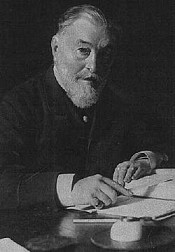
Frederic Harrison (18 October 1831–14 January 1923) was a British jurist and historian. He was born in London although members of his family (originally Leicestershire yeomen) had been lessees of Sutton Place, Guildford, of which he wrote an interesting account (Annals of an Old Manor House, 1893). He was educated at King's College School and Wadham College, Oxford, where, after taking a first-class in Literae Humaniores in 1853, he became fellow and tutor. He was called to the bar in 1858, and, in addition to his practice in equity cases, soon began to distinguish himself as an effective contributor to the higher-class reviews. Two articles in the Westminster Review, one on the Italian question, which procured him the special thanks of Cavour, the other on Essays and Reviews, which had the probably undesigned effect of stimulating the attack on the book, attracted especial notice. A few years later Harrison worked at the codification of the law with Lord Westbury, of whom he contributed an interesting notice to Nash's biography of the chancellor. His special interest in legislation for the working classes led him to be placed upon the Trades Union Commission of 1867-1869; he was secretary to the commission for the digest of the law, 1869-1870; and was from 1877 to 1889 professor of jurisprudence and international law under the council of legal education. A follower of the positive philosophy, but in conflict with Richard Congreve as to details, he led the Positivists who split off and founded Newton Hall in 1881, and he was president of the English Positivist Committee from 1880 to 1905; he was also editor and part author of the Positivist New Calendar of great Men (1892), and wrote much on Comte and Positivism. Of his separate publications, the most important are his lives of Cromwell (1888), William the Silent, (1897), Ruskin (1902), and Chatham (1905); his Meaning of History (1862; enlarged 1894) and Byzantine History in the Early Middle Ages (1900); and his essays on Early Victorian Literature (1896) and The Choice of Books (1886) are remarkable alike for generous admiration and good sense. In 1904 he published a "romantic monograph" of the 10th century, Theophano, and in 1906 a verse tragedy, Nicephorus. An advanced and vehement Radical in politics and Progressive in municipal affairs, Harrison in 1886 stood unsuccessfully for Parliament against Sir John Lubbock for the University of London. In 1889 he was elected an alderman of the London County Council, but resigned in 1893. In 1870 he married Ethel Berta, daughter of William Harrison, by whom he had four sons. George Gissing, the novelist, was at one time their tutor; and in 1905 Harrison wrote a preface to Gissing's Veranilda. As a religious teacher, literary critic, historian and jurist, Harrison took a prominent part in the life of his time, and his writings, though often violently controversial on political and social subjects, and in their judgment and historical perspective characterized by a modern Radical point of view, are those of an accomplished scholar, and of one whose wide knowledge of literature was combined with independence of thought and admirable vigour of style. In 1907 he published The Creed of a Layman, Apologia pro fide mea, in explanation of his religious position. One of his sons was killed in World War I. Later works include Autobiographic Memoirs (1911); The Positive Evolution of Religion (1912); The German Peril (1915); On Society (1918); Jurisprudence and Conflict of Nations (1919); Obiter Scripta (1919); Novissima Verba (1920).
do you like this author?
What readers are saying
What do you think? Write your own comment on this book!
write a commentWhat readers are saying
What do you think? Write your own comment on this author!
write a commentBook list

realities and ideals social political literary and artistic
Series:
Unknown
Year:
Unknown
Raiting:
4/5
Originally published in 1922. This volume from the Cornell University Library's print collections was scanned on an APT BookScan and converted to JPG 2000 format by Kirtas Technologies. All titles scanned cover to cover and pages may include marks, notations and other marginalia present in the original volume.
Show more
add to favoritesadd In favorites

order and progress
Series:
Unknown
Year:
Unknown
Raiting:
4/5
This scarce antiquarian book is included in our special Legacy Reprint Series. In the interest of creating a more extensive selection of rare historical book reprints, we have chosen to reproduce this title even though it may possibly have occasional imperfections such as missing and blurred pages, missing text, poor pictures, markings, dark backgrounds and other reproduction issues beyond our control. Because this work is culturally important, we have made it available as a part of our commitment to protecting, preserving and promoting the world's literature. --This text refers to the Paperback edition.
Show more
add to favoritesadd In favorites

on society
Series:
Unknown
Year:
Unknown
Raiting:
4/5
Purchase of this book includes free trial access to www.million-books.com where you can read more than a million books for free. This is an OCR edition with typos. Excerpt from book: LECTURE III (Newton Hall, 1893. Ethical Societies, 1895-1900) THE FUNCTIONS OF THE STATE If there is one thing which is more peculiarly characteristic of scientific Philosophy and Scientific Polity, it is this : that it looks on society as a living organismâan infinitely complex organic system of mutually correlated organs, indispensable to each other, and having really no independent life. Human nature is not a bundle of sticks or a sack of potatoes. It is a living body; and it can no more, be truly separated into parts than a living man can be separated into a digestive apparatus and a nervous system. Society is an Organism and it must be treated as a whole. The elements of society (i.e., of Humanity) can be separated only in thoughtânot in fact. The State, the Church, Law, Public Opinion, Economics, Ethics, are subjects which we may reason about separately, and detach in the abstract. But for all purposes of concreteapplication we must consider them as depending one on each other. Now the popular social and political schemes treat society piecemeal, in arbitrary sections. They study society in analytic groups, and then they begin to act as if these groups were separable factors. It is as though physicians and surgeons, after studying the physical organism first as skeleton, then as nervous and digestive apparatus, then as a circulating systemâwere to begin to treat any one of them by itself, as if bone, heart, or brain could be treated by drugs or instruments apart from the rest of the body, and without reference to any reaction such treatment might cause elsewhere. The Socialist, the Communist, the Co-operator, the Democratic reformer, the Land Reformer, the suffrage reformer, the Temperance or Sex agitation, confine themselves to one definite element or capacit...
Show more
add to favoritesadd In favorites
Book list
realities and ideals social political literary and artistic
Series:
Unknown
Year:
Unknown
Raiting:
4/5
Originally published in 1922. This volume from the Cornell University Library's print collections was scanned on an APT BookScan and converted to JPG 2000 format by Kirtas Technologies. All titles scanned cover to cover and pages may include marks, notations and other marginalia present in the original volume.
Show more
add to favoritesadd In favorites
order and progress
Series:
Unknown
Year:
Unknown
Raiting:
4/5
This scarce antiquarian book is included in our special Legacy Reprint Series. In the interest of creating a more extensive selection of rare historical book reprints, we have chosen to reproduce this title even though it may possibly have occasional imperfections such as missing and blurred pages, missing text, poor pictures, markings, dark backgrounds and other reproduction issues beyond our control. Because this work is culturally important, we have made it available as a part of our commitment to protecting, preserving and promoting the world's literature. --This text refers to the Paperback edition.
Show more
add to favoritesadd In favorites
on society
Series:
Unknown
Year:
Unknown
Raiting:
4/5
Purchase of this book includes free trial access to www.million-books.com where you can read more than a million books for free. This is an OCR edition with typos. Excerpt from book: LECTURE III (Newton Hall, 1893. Ethical Societies, 1895-1900) THE FUNCTIONS OF THE STATE If there is one thing which is more peculiarly characteristic of scientific Philosophy and Scientific Polity, it is this : that it looks on society as a living organismâan infinitely complex organic system of mutually correlated organs, indispensable to each other, and having really no independent life. Human nature is not a bundle of sticks or a sack of potatoes. It is a living body; and it can no more, be truly separated into parts than a living man can be separated into a digestive apparatus and a nervous system. Society is an Organism and it must be treated as a whole. The elements of society (i.e., of Humanity) can be separated only in thoughtânot in fact. The State, the Church, Law, Public Opinion, Economics, Ethics, are subjects which we may reason about separately, and detach in the abstract. But for all purposes of concreteapplication we must consider them as depending one on each other. Now the popular social and political schemes treat society piecemeal, in arbitrary sections. They study society in analytic groups, and then they begin to act as if these groups were separable factors. It is as though physicians and surgeons, after studying the physical organism first as skeleton, then as nervous and digestive apparatus, then as a circulating systemâwere to begin to treat any one of them by itself, as if bone, heart, or brain could be treated by drugs or instruments apart from the rest of the body, and without reference to any reaction such treatment might cause elsewhere. The Socialist, the Communist, the Co-operator, the Democratic reformer, the Land Reformer, the suffrage reformer, the Temperance or Sex agitation, confine themselves to one definite element or capacit...
Show more
add to favoritesadd In favorites
 add to favoritesadd In favorites

obiter scripta 1918
Series:
Unknown
Year:
Unknown
Raiting:
4.5/5
Originally published in 1919. This volume from the Cornell University Library's print collections was scanned on an APT BookScan and converted to JPG 2000 format by Kirtas Technologies. All titles scanned cover to cover and pages may include marks notations and other marginalia present in the original volume.
Show more
add to favoritesadd In favorites
 add to favoritesadd In favorites
nicephorus a tragedy of new rome
Series:
Unknown
Year:
Unknown
Raiting:
3/5
This volume is produced from digital images created through the University of Michigan University Library's large-scale digitization efforts. The Library seeks to preserve the intellectual content of items in a manner that facilitates and promotes a variety of uses. The digital reformatting process results in an electronic version of the original text that can be both accessed online and used to create new print copies. The Library also understands and values the usefulness of print and makes reprints available to the public whenever possible. This book and hundreds of thousands of others can be found in the HathiTrust, an archive of the digitized collections of many great research libraries. For access to the University of Michigan Library's digital collections, please see http://www.lib.umich.edu and for information about the HathiTrust, please visit http://www.hathitrust.org
Show more
add to favoritesadd In favorites

national and social problems
Series:
Unknown
Year:
Unknown
Raiting:
2.5/5
Originally published in 1908. This volume from the Cornell University Library's print collections was scanned on an APT BookScan and converted to JPG 2000 format by Kirtas Technologies. All titles scanned cover to cover and pages may include marks notations and other marginalia present in the original volume. --This text refers to an alternate Paperback edition.
Show more
add to favoritesadd In favorites
my alpine jubilee 1851 1907
Series:
Unknown
Year:
Unknown
Raiting:
3.5/5
Purchase of this book includes free trial access to www.million-books.com where you can read more than a million books for free. This is an OCR edition with typos. Excerpt from book: THE ALPS ONCE MORE (A letter published by ' The Times' in 1906.) Axenstein : Sept. 20, 1906 Here, in Axenstein, in view of the historic cradle of Swiss liberty, and amidst some of the sublimest scenes in Europe, we have enjoyed the pleas you have made for the preservation of these wonderful works of Nature, and for the due use of them by foreign tourists. It is now exactly fifty-five years since I first saw this lake and these crags ; and in my old age I return to them and find them somewhat changed in the half-centurythough the change is the work of man, no wise the work of Nature. Nature is as lovely, as sublime, as ever, and the railways, pensions and grand hotels, motors and circular trippers, are after all but scratches on the surface and flies upon thegranite rock. Will you allow me to jot down a few thoughts from the experience of more than half a century ? It is common observation that in many parts of Switzerland, and those some of the most interesting and beautiful, the English are now but seldom to be found. In my young days the English were about three-fourths of the travellers. To-day, in some of the most beautiful haunts, they are rather one-fifth, or even one-tenth. Of course other nations, especially the German and Italian, have gained in half a century enormous facilities of access, and also in wealth, energy, and ambition. And it is often said that Switzerland is exhausted, connu, hackneyed to Englishmen. But this is not the truth, or the whole truth. It cannot be ; for if most English men and women of leisure and means at middle age have already visited the great centres of the Alps, the younger generation has not had time or opportunity yet to do so, and the vast increase of facilities for tours must have tapped an area of myriads of new tourists. ...
Show more
add to favoritesadd In favorites

memories and thoughts men books cities art
Series:
Unknown
Year:
Unknown
Raiting:
5/5
Originally published in 1889. This volume from the Cornell University Library's print collections was scanned on an APT BookScan and converted to JPG 2000 format by Kirtas Technologies. All titles scanned cover to cover and pages may include marks, notations and other marginalia present in the original volume.
Show more
add to favoritesadd In favorites
add to favoritesadd In favorites

george washington and other american addresses
Series:
Unknown
Year:
Unknown
Raiting:
2.5/5
This volume is produced from digital images created through the University of Michigan University Library's preservation reformatting program. The Library seeks to preserve the intellectual content of items in a manner that facilitates and promotes a variety of uses. The digital reformatting process results in an electronic version of the text that can both be accessed online and used to create new print copies. This book and thousands of others can be found in the digital collections of the University of Michigan Library. The University Library also understands and values the utility of print, and makes reprints available through its Scholarly Publishing Office.
Show more
add to favoritesadd In favorites

chatham
Series:
Unknown
Year:
Unknown
Raiting:
5/5
CONTENTS CHAPTER I PAGE INTRODUCTORY 1 EARLY LIFE CHAPTER II CHAPTER III THE RISING ORATOR .24 CHAPTER IV THE ASPIRANT FOR OFFICE ...... 44 CHAPTER V IN SUBORDINATE OFFICE 57 CHAPTER VI FIRST MINISTRY 75 vi CONTENTS CHAPTER VII PAGE FALL FROM POWER 119 CHAPTER VIII IN OPPOSITION.... . 143 CHAPTER IX THE CHATHAM MINISTRY 169 CHAPTER X DEFENCE OF IRELAND AND INDIA . 191 CHAPTER XI DEFENCE OF THE CONSTITUTION 206 CHAPTER XII DEFENCE OF AMERICA .... 225 APPENDIX ,238 CHAPTER I INTRODUCTORY Posterity, this is an impartial picture. I am neither dazzled by the blaze of the times in which Ihave lived, nor, if there are spots in the sun, do I deny that I see them. It is a man Iam describing, and one, whose greatness will bear to have his blemishesfairly delivered to you notfrom a love ofcensure in me, but oftruth and because it is history Iam writing, not romance. SUCH was the judgment passed on Chatham by a hostile contemporary, whose Memoirs were withheld from the public eye for nearly a century after their compilation. In these words Horace Walpole sums up his incisive character of the terrible cornet of horse whom Sir Robert Walpole attempted to muzzle, of the aspiring orator who contributed so much to the fall of Sir Robert, of the imperious statesman who finally succeeded to more than the power of Walpole at his zenith, reversed his policy, and entirely recast the international position world. of Great Britain in the In eight centuries our country has known but four great creative statesmen men who, to use the words of a well-known historian, have been founders or creators of a new order of things. William the Conqueror made all England an organic nation. Edward the First conceived the union of all Britain. Cromwell made the United Kingdom and founded our Sea Power. Chatham made the Colonial System and was the founder of the Empire. For good and for evil, through heroism and through spoliation, with all its vast and far-reachingconsequences, industrial, economic, social, and moral the foundation of the Empire was the work of Chatham. He changed the course of Englands history nay, the course of modern history. For a century and a half the development of our country has grown upon the imperial lines of Chathams ideals and succeeding statesmen have based the keynote of their policy on enlarging the range of these ideals, in warding off the dangers they involved, in curbing or in stimulating the excesses they bred. Frederick of Prussia said of Chatham, England has long been in labour, and has suffered much to produce Mr. Pitt but at last she has brought forth a man. By France, the rise and fall of Chatham was watched as equivalent to the loss or the gain of a decisive campaign. His hyperbolic self-will, his almost grotesque arrogance, seemed excused by the deference of all with whom he acted, and the timidity of all whom he confronted. Contemporary memoirs ring with anecdotes of his personal ascendency and the terror he inspired at home and abroad. When Chatham said to a colleague, I know that I can save this country, and that no one else can, it was not regarded as arrogance and presumption, but was treated as simple truth, which no doubt it was. Walpoles famous character of Chatham, from which a sentence heads this chapter, runs thus The admirers of Mr. Pitt extol the reverberation he gives to our councils, the despondence he banished, the spirit he infused, the conquests he made, the security he affixed to our trade and plantations, the humiliations of France, the glory of Britain carried under his minis- trations to a pitch at which it never had arrived and all this is exactly true... --This text refers to an alternate Paperback edition.
Show more
add to favoritesadd In favorites
carlyle and the london library account of its foundation together with unpubli
Series:
Unknown
Year:
Unknown
Raiting:
4/5
Show more
add to favoritesadd In favorites
add to favoritesadd In favorites
add to favoritesadd In favorites
annals of an old manor house sutton place guildford
Series:
Unknown
Year:
Unknown
Raiting:
4/5
Show more
add to favoritesadd In favorites
add to favoritesadd In favorites
What readers are saying
What do you think? Write your own comment on this author!
write a commentif you like Harrison Frederic try:
readers also enjoyed
What readers are saying
What do you think? Write your own comment on this author!
write a commentGenre
if you like Harrison Frederic try:
readers also enjoyed
Do you want to read a book that interests you? It’s EASY!
Create an account and send a request for reading to other users on the Webpage of the book!

