Doyle Arthur Conan Sir
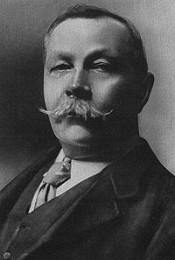
Sir Arthur Ignatius Conan Doyle, DL (22 May 1859 – 7 July 1930) was a British physician and writer, most noted for his stories about the detective Sherlock Holmes, which are generally considered a major innovation in the field of crime fiction, and for the adventures of Professor Challenger. He was a prolific writer whose other works include science fiction stories, historical novels, plays and romances, poetry, and non-fiction. Arthur Conan Doyle was born on 22 May 1859 in Edinburgh, Scotland, to an English father of Irish descent, Charles Altamont Doyle, and an Irish mother, née Mary Foley, who had married in 1855.[1] Although he is now referred to as "Conan Doyle", the origin of this compound surname (if that is how he meant it to be understood) is uncertain. The entry in which his baptism is recorded in the register of St Mary's Cathedral in Edinburgh gives 'Arthur Ignatius Conan' as his Christian name, and the simple 'Doyle' as his surname. It also names Michael Conan as his godfather. [2] Conan Doyle was sent to the Roman Catholic Jesuit preparatory school Hodder Place, Stonyhurst, at the age of nine. He then went on to Stonyhurst College, but by the time he left the school in 1875, he had rejected Christianity to become an agnostic. From 1876 to 1881, he studied medicine at the University of Edinburgh, including a period working in the town of Aston (now a district of Birmingham) and in Sheffield.[3] While studying, he also began writing short stories; his first published story appeared in Chambers's Edinburgh Journal before he was 20.[4] Following his term at university, he served as a ship's doctor on a voyage to the West African coast. He completed his doctorate on the subject of tabes dorsalis in 1885.[5] In 1882, he joined former classmate George Budd as his partner at a medical practice in Plymouth,[6] but their relationship proved difficult, and Conan Doyle soon left to set up an independent practice.[7] Arriving in Portsmouth in June of that year with less than £10 to his name, he set up a medical practice at 1 Bush Villas in Elm Grove, Southsea.[8] The practice was initially not very successful; while waiting for patients, he again began writing stories. His first significant work was A Study in Scarlet, which appeared in Beeton's Christmas Annual for 1887 and featured the first appearance of Sherlock Holmes, who was partially modelled after his former university professor Joseph Bell, to whom Conan Doyle wrote "It is most certainly to you that I owe Sherlock Holmes. ... [R]ound the centre of deduction and inference and observation which I have heard you inculcate I have tried to build up a man."[9] Future short stories featuring Sherlock Holmes were published in the English Strand Magazine. Interestingly enough, Robert Louis Stevenson was able, even in faraway Samoa, to recognise the strong similarity between Joseph Bell and Sherlock Holmes: "[M]y compliments on your very ingenious and very interesting adventures of Sherlock Holmes. ... [C]an this be my old friend Joe Bell?"[10] Other authors sometimes suggest additional influences—for instance, the famous Edgar Allan Poe character, C. Auguste Dupin.[11] In 1885, he married Louisa (or Louise) Hawkins, known as "Touie", who suffered from tuberculosis and died on 4 July 1906.[14] He married Jean Elizabeth Leckie in 1907, whom he had first met and fallen in love with in 1897, but had maintained a platonic relationship with her while his first wife Louisa was still alive, out of loyalty to her. Jean died in London on 27 June 1940. Conan Doyle had five children, two with his first wife (1) Mary Louise (28 January 1889 – 12 June 1976) and (2) Arthur Alleyne Kingsley, known as Kingsley (15 November 1892 – 28 October 1918), and three with his second wife, (3) Denis Percy Stewart (17 March 1909 – 9 March 1955), second husband in 1936 of Georgian Princess Nina Mdivani (circa 1910 – 19 February 1987; former sister-in-law of Barbara Hutton), (4) Adrian Malcolm (1910 – 1970) and (5) Jean Lena Annette (1912 – 1997). In 1890, Conan Doyle studied the eye in Vienna; he moved to London in 1891 to set up a practice as an ophthalmologist. He wrote in his autobiography that not a single patient crossed his door. This gave him more time for writing, and in November 1891 he wrote to his mother: "I think of slaying Holmes ... and winding him up for good and all. He takes my mind from better things." His mother responded, saying, "You may do what you deem fit, but the crowds will not take this lightheartedly." In December 1893, he did so in order to dedicate more of his time to more "important" works — his historical novels. Holmes and Moriarty apparently plunged to their deaths together down the Reichenbach Falls in the story "The Final Problem". Public outcry led him to bring the character back; Conan Doyle returned to the story in "The Adventure of the Empty House", with the explanation that only Moriarty had fallen but, since Holmes had other dangerous enemies, especially Colonel Sebastian Moran, he had arranged to be temporarily "dead" also. Holmes ultimately appeared in a total of 56 short stories and four Conan Doyle novels (he has since appeared in many novels and stories by other authors). Following the Boer War in South Africa at the turn of the 20th century and the condemnation from around the world over the United Kingdom's conduct, Conan Doyle wrote a short pamphlet titled, The War in South Africa: Its Cause and Conduct, which justified the UK's role in the Boer war and was widely translated. Conan Doyle believed that it was this pamphlet that resulted in his being knighted in 1902 and appointed Deputy-Lieutenant of Surrey. He also, in 1900, wrote the longer book, The Great Boer War. During the early years of the 20th century, Sir Arthur twice ran for Parliament as a Liberal Unionist, once in Edinburgh and once in the Hawick Burghs, but although he received a respectable vote, he was not elected. Conan Doyle was involved in the campaign for the reform of the Congo Free State, led by the journalist E.D. Morel and the diplomat Roger Casement. During 1909, he wrote The Crime of the Congo, a long pamphlet in which he denounced the horrors in that country. He became acquainted with Morel and Casement and it is possible that together with Bertram Fletcher Robinson,[15] they inspired several characters in the novel, The Lost World (1912). He broke with both when Morel became one of the leaders of the pacifist movement during the First World War, and when Casement was convicted of treason against the UK during the Easter Rising. Conan Doyle tried, unsuccessfully, to save Casement from the death penalty, arguing that he had been driven mad and was not responsible for his actions. Conan Doyle was also a fervent advocate of justice and personally investigated two closed cases, which led to two men being exonerated of the crimes they were accused of. The first case, in 1906, involved a shy half-British, half-Indian lawyer named George Edalji, who had allegedly penned threatening letters and mutilated animals. Police were set on Edalji's conviction, even though the mutilations continued after their suspect was jailed. It was partially as a result of this case that the Court of Criminal Appeal was established in 1907, so not only did Conan Doyle help George Edalji, his work helped establish a way to correct other miscarriages of justice. The story of Conan Doyle and Edalji is told in fictional form in Julian Barnes' 2005 novel, Arthur & George. The second case, that of Oscar Slater, a German Jew and gambling-den operator convicted of bludgeoning an 82-year-old woman in Glasgow in 1908, excited Conan Doyle's curiosity because of inconsistencies in the prosecution case and a general sense that Slater was framed. After the death of his wife Louisa in 1906, and the death of his son Kingsley, his brother Innes, his two brothers-in-law (one of whom was E. W. Hornung, the creator of the literary character Raffles), and his two nephews shortly after World War I, Conan Doyle sank into depression. He found solace supporting Spiritualism and its alleged scientific proof of existence beyond the grave. Kingsley Doyle died from pneumonia on 28 October 1918, which he contracted during his convalescence after being seriously wounded during the 1916 Battle of the Somme. Brigadier-General Innes Doyle died in February 1919, also from pneumonia. Sir Arthur became involved with Spiritualism to the extent that he wrote a Professor Challenger novel on the subject, The Land of Mist. His book, The Coming of the Fairies (1921) shows he was apparently convinced of the veracity of the Cottingley Fairies photographs, which he reproduced in the book, together with theories about the nature and existence of fairies and spirits. In his The History of Spiritualism (1926), Conan Doyle praised the psychic phenomena and spirit materialisations produced by Eusapia Palladino and Mina "Margery" Crandon.[16] His work on this topic was one of the reasons that one of his short story collections, The Adventures of Sherlock Holmes, was banned in the Soviet Union in 1929 for supposed occultism. This ban was later lifted.[when?] Russian actor Vasily Livanov later received an Order of the British Empire for his portrayal of Sherlock Holmes. Conan Doyle was friends for a time with the American magician Harry Houdini, who himself became a prominent opponent of the Spiritualist movement in the 1920s following the death of his beloved mother. Although Houdini insisted that Spiritualist mediums employed trickery (and consistently attempted to expose them as frauds), Conan Doyle became convinced that Houdini himself possessed supernatural powers, a view expressed in Conan Doyle's The Edge of the Unknown. Houdini was apparently unable to convince Conan Doyle that his feats were simply magic tricks, leading to a bitter public falling out between the two.[16] Richard Milner, an American historian of science, has presented a case that Conan Doyle may have been the perpetrator of the Piltdown Man hoax of 1912, creating the counterfeit hominid fossil that fooled the scientific world for over 40 years. Milner says that Conan Doyle had a motive, namely revenge on the scientific establishment for debunking one of his favourite psychics, and that The Lost World contains several encrypted clues regarding his involvement in the hoax.[17]


Users Who added
to favorites

if you like Doyle Arthur Conan Sir try:
readers also enjoyed
Users Who added
to favorites
Do you want to read a book that interests you? It’s EASY!
Create an account and send a request for reading to other users on the Webpage of the book!

