Crockett Samuel Rutherford
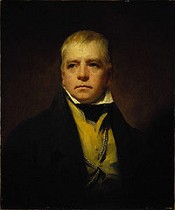
Sir Walter Scott, 1st Baronet (15 August 1771 – 21 September 1832) was a prolific Scottish historical novelist and poet, popular throughout Europe during his time. Scott was particularly associated with Toryism. Scott was the first English-language author to have a truly international career in his lifetime, with many contemporary readers in Europe, Australia, and North America. His novels and poetry are still read, and many of his works remain classics of both English-language literature and of Scottish literature. Famous titles include Ivanhoe, Rob Roy, The Lady of The Lake, Waverley, The Heart of Midlothian and The Bride of Lammermoor. Born in College Wynd in the Old Town of Edinburgh in 1771, the son of a solicitor, Scott survived a childhood bout of polio in 1773 that left him lame. To cure his lameness he was sent in 1773 to live in the rural Borders region at his grandparents' farm at Sandyknowe, adjacent to the ruin of Smailholm Tower, the earlier family home. Here he was taught to read by his aunt Jenny, and learned from her the speech patterns and many of the tales and legends that characterized much of his work. In January 1775 he returned to Edinburgh, and that summer went with his aunt Jenny to take spa treatment at Bath in England, where they lived at 6 South Parade.[1] In the winter of 1776 he went back to Sandyknowe, with another attempt at a water cure at Prestonpans during the following summer.[2] In 1778 Scott returned to Edinburgh for private education to prepare him for school, and in October 1779 he began at the Royal High School of Edinburgh. He was now well able to walk and explore the city and the surrounding countryside. His reading included chivalric romances, poems, history and travel books. He was given private tuition by James Mitchell in arithmetic and writing, and learned from him the history of the Kirk with emphasis on the Covenanters. After finishing school he was sent to stay for six months with his aunt Jenny in Kelso, attending the local Grammar School where he met James Ballantyne who later became his business partner and printed his books.[3] Scott began studying classics at the University of Edinburgh in November 1783, at the age of only 12, a year or so younger than most of his fellow students. In March 1786 he began an apprenticeship in his father's office, to become a Writer to the Signet. While at the university Scott had become a friend of Adam Ferguson, the son of Professor Adam Ferguson who hosted literary salons. Scott met the blind poet Thomas Blacklock who lent him books as well as introducing him to James Macpherson's Ossian cycle of poems. During the winter of 1786–87 the 15-year-old Scott saw Robert Burns at one of these salons, for what was to be their only meeting. When Burns noticed a print illustrating the poem "The Justice of the Peace" and asked who had written the poem, only Scott knew that it was by John Langhorne, and was thanked by Burns.[4] When it was decided that he would become a lawyer he returned to the university to study law, first taking classes in Moral Philosophy and Universal History in 1789–90.[3] After completing his studies in law, he became a lawyer in Edinburgh. As a lawyer's clerk he made his first visit to the Scottish Highlands directing an eviction. He was admitted to the Faculty of Advocates in 1792. He had an unsuccessful love suit with Williamina Belsches of Fettercairn, who married Sir William Forbes, 6th Baronet. At the age of 25 he began dabbling in writing, translating works from German, his first publication being rhymed versions of ballads by Bürger in 1796. He then published a three-volume set of collected Scottish ballads, The Minstrelsy of the Scottish Border. This was the first sign of his interest in Scottish history from a literary standpoint. Scott then became an ardent volunteer in the yeomanry and on one of his "raids" he met at Gilsland Spa Margaret Genevieve Charpentier (or Charpenter), daughter of Jean Charpentier of Lyon in France, whom he married in 1797. They had five children. In 1799 he was appointed Sheriff-Deputy of the County of Selkirk, based in the Royal Burgh of Selkirk. In his early married days Scott had a decent living from his earnings at the law, his salary as Sheriff-Deputy, his wife's income, some revenue from his writing and his share of his father's rather meagre estate. After Scott had founded a printing press, his poetry, beginning with The Lay of the Last Minstrel in 1805, brought him fame. He published other poems over the next ten years, including the popular The Lady of the Lake, printed in 1810 and set in the Trossachs. Portions of the German translation of this work were set to music by Franz Schubert. One of these songs, Ellens dritter Gesang, is popularly labelled as "Schubert's Ave Maria". Another work from this period, Marmion, produced some of his most quoted (and mis-attributed) lines. Canto VI. Stanza 17 reads: In 1809 his sympathies led him to become a co-founder of the Quarterly Review, a review journal to which he made several anonymous contributions. In 1813 he was offered the position of Poet Laureate. He declined and the position went to Robert Southey.[5] When the press became embroiled in pecuniary difficulties, Scott set out in 1814 to write a cash-cow. The result was Waverley, a novel that did not name its author. It was a tale of the "Forty-Five" Jacobite rising in the Kingdom of Great Britain with its English protagonist Edward Waverley, by his Tory upbringing sympathetic to Jacobitism, becoming enmeshed in events but eventually choosing Hanoverian respectability. The novel met with considerable success. There followed a succession of novels over the next five years, each with a Scottish historical setting. Mindful of his reputation as a poet, he maintained the anonymous habit he had begun with Waverley, always publishing the novels under the name Author of Waverley or attributed as "Tales of..." with no author. Even when it was clear that there would be no harm in coming out into the open he maintained the façade, apparently out of a sense of fun. During this time the nickname The Wizard of the North was popularly applied to the mysterious best-selling writer. His identity as the author of the novels was widely rumoured, and in 1815 Scott was given the honour of dining with George, Prince Regent, who wanted to meet "the author of Waverley". In 1819 he broke away from writing about Scotland with Ivanhoe, a historical romance set in 12th-century England. It too was a runaway success and he wrote several books along the same lines. Among other things the book is noteworthy for having a very sympathetic Jewish major character, Rebecca, considered by many critics to be the book's real heroine — relevant to the fact that the book was published at a time when the struggle for the Emancipation of the Jews in England was gathering momentum. Scott wrote "The Bride of Lammermoor", a novel based on a true story of two lovers. In the novel, Lucie Ashton and Edgar Ravenswood exchange vows, but when Lucie's mother discovers that her daughter wants to wed an enemy of their family, she intervenes and forces her daughter to marry Sir Arthur Bucklaw, who has just inherited a large sum of money on the death of his aunt. On their wedding night, Lucie goes insane and stabs the bridegroom, and succumbing to insanity, dies. Donizetti's opera "Lucia di Lamermoor" was based on Scott's novel. As his fame grew he was granted the title of baronet, becoming Sir Walter Scott. He organized the visit of King George IV to Scotland, and when the King visited Edinburgh in 1822 the spectacular pageantry that Scott had concocted to portray George as a rather tubby reincarnation of Bonnie Prince Charlie made tartans and kilts fashionable and turned them into symbols of Scottish national identity. Scott included little in the way of punctuation in his drafts, which he left to the printers to supply.[6] He eventually acknowledged that he was the author of the Waverley novels in 1827.[7] Beginning in 1825 he went into dire financial straits again, as his company nearly collapsed. Rather than declare bankruptcy he placed his home, Abbotsford House, and income into a trust belonging to his creditors, and proceeded to write his way out of debt. He kept up his prodigious output of fiction (as well as producing a biography of Napoléon Bonaparte) until 1831. By then his health was failing, and he died at Abbotsford in 1832. Though he died in debt his novels continued to sell, and he made good his debts from beyond the grave. He was buried in Dryburgh Abbey where nearby there is a large statue of William Wallace, one of Scotland's many romanticised historical figures. When Scott was a boy he sometimes travelled with his father from Selkirk to Melrose in the Border Country where some of his novels are set. At a certain spot the old gentleman would stop the carriage and take his son to a stone on the site of the battle of Melrose (1526). Not far away was a little farm called Cartleyhole, and this he eventually purchased. The farmhouse developed into a wonderful home that has been likened to a fairy palace. Through windows enriched with the insignia of heraldry the sun shone on suits of armour, trophies of the chase, a library of over 9,000 volumes,[8] fine furniture, and still finer pictures. Panelling of oak and cedar and carved ceilings relieved by coats of arms in their correct colour added to the beauty of the house. More land was purchased until Scott owned nearly 1,000 acres (4 km²), and it is estimated that the building cost him over £25,000. A neighbouring Roman road with a ford used in olden days by the abbots of Melrose suggested the name of Abbotsford. The last of his direct descendants to inhabit Abbotsford House was his great-great-great-granddaughter Dame Jean Maxwell-Scott (8 June 1923 - 7 July 2004). She inherited it from her elder sister Patricia in 1998. The sisters turned the house into one of Scotland's premier tourist attractions after they had to rely on paying visitors to afford the upkeep of the house. It had electricity installed only in 1962. Dame Jean was at one time a lady-in-waiting to Princess Alice, Duchess of Gloucester; patron of the Dandie Dinmont Club, a breed of dog named after one of Sir Walter Scott's characters; and a horse trainer, one of whose horses, Sir Wattie, ridden by Ian Stark, won two silver medals at the 1988 Summer Olympics in Seoul, South Korea.[9]



Do you want to exchange books? It’s EASY!
Get registered and find other users who want to give their favourite books to good hands!

