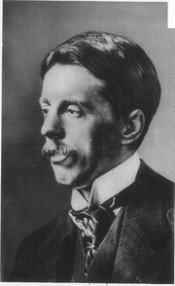
Bennett Arnold
Enoch Arnold Bennett (27 May 1867 – 27 March 1931) was an English novelist. Bennett was born in a modest house in Hanley in the Potteries district of Staffordshire. Hanley is one of a conurbation of six towns which joined together at the beginning of the twentieth century as Stoke-on-Trent. Enoch Bennett, his father, qualified as a solicitor in 1876, and the family were able to move to a larger house between Hanley and Burslem.[1] The younger Bennett was educated locally in Newcastle-under-Lyme. Arnold was employed by his father - his duties included rent collecting. He was unhappy working for his father for little financial reward, and the theme of parental miserliness is important in his novels. In his spare time he was able to do a little journalism, but his breakthrough as a writer was to come after he had moved from his native Potteries. At the age of twenty-one, he left his father's practice and went to London as a solicitor's clerk. Bennett won a literary competition in Tit-Bits magazine in 1889 and was encouraged to take up journalism full time. In 1894, he became assistant editor of the periodical Woman. He noticed that the material offered by a syndicate to the magazine was not very good, so he wrote a serial which was bought by the syndicate for 75 pounds. He then wrote another. This became The Grand Babylon Hotel. Just over four years later, his first novel, A Man from the North, was published to critical acclaim and he became editor of the magazine. From 1900 he devoted himself full time to writing, giving up the editorship and writing much serious criticism, and also theatre journalism, one of his special interests. He moved to Trinity Hall Farm, Hockliffe, Bedfordshire, on Watling Street, which was the inspiration for his novel Teresa of Watling Street, which was published in 1904. His father died there in 1902 and is buried in Chalgrove churchyard. In 1902, Anna of the Five Towns, the first of a succession of stories which detailed life in the Potteries, appeared. In 1903, he moved to Paris, where other great artists from around the world had converged on Montmartre and Montparnasse. Bennett spent the next eight years writing novels and plays. In 1908 The Old Wives' Tale was published and was an immediate success throughout the English-speaking world. After a visit to America in 1911, where he had been publicised and acclaimed as no other visiting writer since Dickens, he returned to England where Old Wives' Tale was reappraised and hailed as a masterpiece. During the First World War he became Director of Propaganda for France at the Ministry of Information. His appointment was made directly on the recommendation of Lord Beaverbrook, who also recommended him as Deputy Minister of that Department at the end of the war.[2] He refused a knighthood in 1918. He won the 1923 James Tait Black Memorial Prize for his novel Riceyman Steps and in 1926, at the suggestion of Lord Beaverbrook, he began writing an influential weekly article on books for the Evening Standard newspaper. Osbert Sitwell,[3] in a letter to James Agate,[4] notes that Bennett was not, despite current views, "the typical businessman, with his mean and narrow outlook". Sitwell cited a letter from Bennett to a friend of Agate, who remains anonymous, in Ego 5: I find I am richer this year than last; so I enclose a cheque for 500 pounds for you to distribute among young writers and artists and musicians who may need the money. You will know, better than I do, who they are. But I must make one condition, that you do not reveal that the money has come from me, or tell anyone about it. He separated from his French wife in 1922 and fell in love with the actress Dorothy Cheston, with whom he stayed for the rest of his life. He died of typhoid at his home in Baker Street, London, on 27 March 1931. His ashes are buried in Burslem cemetery. Their daughter, Virginia Eldin, lived in France and was president of the Arnold Bennett Society. His most famous works are the Clayhanger trilogy and The Old Wives' Tale. These books draw on his experience of life in the Potteries, as did most of his best work. In his novels the Potteries are referred to as "the Five Towns"; Bennett felt that the name was more euphonious than "the Six Towns" so Fenton was omitted. The real towns and their Bennett counterparts are: Bennett believed that ordinary people had the potential to be the subject of interesting books. In this respect, an influence which Bennett himself acknowledged was the French writer Maupassant whose "Une Vie" inspired "The Old Wives' Tale". Maupassant is also one of the writers on whom Richard Larch, the protagonist of Bennett's first (and obviously semi-autobiographical) novel, A Man from the North, tries in vain to model his own writing. As well as the novels, much of Bennett's non-fiction work has stood the test of time. One of his most popular non-fiction works, which is still read to this day, is the self-help book "How to Live on 24 Hours a Day". His diaries have yet to be published in full, but extracts from them are often quoted in the British press. Bennett also wrote for the stage and the screen. His novel Buried Alive was made into the 1912 movie The Great Adventure and the 1968 musical Darling of the Day. Over the years, several of his other books have been made into films (for example The Card starring Alec Guinness) and television mini-series (such as "Anna of the Five Towns" and "Clayhanger"). Critically, Bennett has not always had an easy ride. His output was prodigious and, by his own admission, based on maximising his income rather than from creative necessity. As Bennett put it: "Am I to sit still and see other fellows pocketing two guineas apiece for stories which I can do better myself? Not me. If anyone imagines my sole aim is art for art’s sake, they are cruelly deceived." Contemporary critics—Virginia Woolf in particular—perceived weaknesses in his work. To her and other Bloomsbury authors, Bennett represented the "old guard" in literary terms. His style was traditional rather than modern, which made him an obvious target for those challenging literary conventions.[5][6] Max Beerbohm criticized him as a social climber who had forgotten his roots. He drew a mature and well fed Bennett expounding "All to plan, you see" to a younger tougher version of himself, who replies: "Yes - but MY plan". For much of the 20th Century, Bennett's work was tainted by this perception; it was not until the 1990s that a more positive view of his work became widely accepted. The noted English critic John Carey was a major influence on his rehabilitation. He praises him in his 1992 book, The Intellectuals and the Masses. ISBN 978-0571169269. , declaring Bennett to be his "hero" because his writings "represent a systematic dismemberment of the intellectuals' case against the masses" (p. 152). Fiction Non-fiction Film Opera For further guidance consult Studies in the sources of Arnold Bennett's novels by Louis Tillier (Didier, Paris 1949), and Arnold Bennett and Stoke-on-Trent by E. J. D. Warrilow (Etruscan Publications, 1966). Also, Arnold Bennett: A Biography by Margaret Drabble (Weidenfeld & Nicolson, London 1974). Bennett is one of a select number of celebrities to have a dish named after them. While staying at the Savoy Hotel in London, the chefs perfected an omelette incorporating smoked haddock, which pleased the author so much he insisted on it being prepared wherever he travelled. The 'Omelette Arnold Bennett' has remained a Savoy standard dish ever since.[7]

anna of the five towns a novel
- Author: Bennett Arnold
- Genre: Literary
This is the story about a young woman's struggles to free herself from the pressure of her tyrannical father. The title character is given a chance to live undreamed-of experiences when she inherits a fortune in properties and business ventures on her 21st birthday. Simultaneously, she finds herself the declared object of affection of one of the town's most desirable men. As her story begins, she is attracted to another man, more vulnerable, and must try to resolve many different demands on her sense of duty and her emotions.
helen with the high hand an idyllic diversion
- Author: Bennett Arnold
- Genre: Literature & Fiction
Arnold Bennett was a famous English writer and journalist. His most famous works are the "Claychange" trilogy and "The Old Wives' Tale". These books draw on his experience of life in the Potteries, as did most of his best work. In his novels the Potteries are referred to as "the Five Towns". If you read this book, you'll know why the Savoy in London serves a dish called "Omelette Arnold Bennett". This is a perfect little book; complete and magical. The warmth of Bennett's humanity glows from the pages. Innocent, funny and absolutely lovely.
Helen with the High Hand (2nd ed.)
- Author: Bennett Arnold
- Genre: History & Criticism
Although the book is pretty short, it is full of very interesting events and characters. Its plot is simply magical and amazing. From each word and on each page you can feel the warmth of the author's soul and his kindness. Although Helen with the High Hand may not seem serious at the first glimpse, it is very entertaining and definitely has its own advantages and appeal for readers.
Judith, a play in three acts
- Author: Bennett Arnold
- Genre: History
Enoch Arnold Bennett (1867-1931) was a British novelist. He was born in a modest house in Hanley in the Potteries district of Staffordshire. At age 21 he went to London as a solicitor's clerk. He won a literary competition in Tit Bits magazine in 1889 and was encouraged to take up journalism full time. From 1900 he devoted himself full time to writing, giving up the editorship and writing much serious criticism, and also theatre journalism, one of his special interests. In 1902 Anna of the Five Towns, the first of a succession of stories which detailed life in the Potteries, appeared. In 1908 The Old Wives' Tale was published, and was an immediate success throughout the English-speaking world. His most famous works are the Clayhanger (1910) trilogy and The Old Wives' Tale. These books draw on his experience of life in the Potteries, as did most of his best work. Among his other books are: The Grand Babylon Hotel (1902), The Grim Smile of the Five Towns (1907), Hilda Lessways (1911), The Author's Craft (1914), The Lion's Share (1916), and The Roll-Call (1919). --This text refers to an alternate Paperback edition.
The Feast of St. Friend
- Author: Bennett Arnold
- Genre: History
This large print title is set in Tiresias 16pt font as recommended by the RNIB. --This text refers to an alternate Paperback edition.
The Author's Craft
- Author: Bennett Arnold
- Genre: Classics
This book was converted from its physical edition to the digital format by a community of volunteers. You may find it for free on the web. Purchase of the Kindle edition includes wireless delivery.
The Great Adventure
- Author: Bennett Arnold
- Genre: Electronic books
Purchase of this book includes free trial access to www.million-books.com where you can read more than a million books for free. This is an OCR edition with typos. Excerpt from book: THE :X GREAT ADVENT-ORE ACT I ,..., Scene i "'"." Front room on ground floor at 126 Redcliffe Gardens. An apartment furnished richly but in an old-fashioned way. Fine pictures. Large furniture. Sofa near centre. General air of neglect and dustiness. Carpet half- laid. Trunks and bags lying about in corners, some opened. Men's wearing apparel exposed. Mantelpiece, R., in disorder. At back double doors (ajar) leading to another room. Door, L., leading to hall and front door. TIME.Evening in August. Albert Shawn is reclining on the sofa, fully dressed, but obviously ill: an overcoat has been drawn over his legs. A conspicuous object is a magnificent light purple dressing- gown thrown across a chair. Door bangs off. Enter I Lam Carve in his shirt sleeves, hurriedly. SHAWN feebly tries to get up. Carve. Now, donlt.niove. Remember you're a sick man, and forget you're a servant. (shawn 'shivers. Carve, about to put on-Ms-dressing-gown, changes his wind, . an'd'wraps it round SHAWN as well as '. 'he can. CARVE then puts on an oldish .-. "; coat.) " . SiiAWN. (Feebly?) You've been very quick, .-.' sir. Carve. I found a red lamp only three doors off. He'll be along in half a minute. Shawn. Did you explain what it was, sir? Carve. (Genially.) How could I explain what it was, you fool, when I don't know ? I simply asked to see the doctor, and I told him there was a fellow-creature suffering at No. 126, and would he come at once. " 126 ? " he said, " 126 has been shut up for years." SHAWN. (Trying to smile) What did you say, sir? CARVE. I said (articulating with clearness) a hundred and twenty-sixand ran off. Then he yelled out after me that he'd come instantly. ... I say, Shawn, we're discovered. I could tell that from his su...
The Title
- Author: Bennett Arnold
- Genre: United States
Books for All Kinds of Readers. ReadHowYouWant offers the widest selection of on-demand, accessible format editions on the market today. Our 7 different sizes of EasyRead are optimized by increasing the font size and spacing between the words and the letters. We partner with leading publishers around the globe. Our goal is to have accessible editions simultaneously released with publishers' new books so that all readers can have access to the books they want to read. To find more books in your format visit www.readhowyouwant.com --This text refers to the Paperback edition.
denry the audacious
- Author: Bennett Arnold
- Genre: History
Purchase of this book includes free trial access to www.million-books.com where you can read more than a million books for free. This is an OCR edition with typos. Excerpt from book: CHAPTER III. THE PANTECHNICON " How do you do, Miss Earp? " said Denry, in a worldly manner which he had acquired for himself by taking the most effective features of the manners of several prominent citizens, and piecing them together so that as a whole they formed Denry's manner. "Oh! How do you do, Mr. Machin?" said Ruth Earp, who had opened her door to him at the corner of Tudor Passage and St. Luke's Square. It was an afternoon in July. Denry wore a new summer suit, whose pattern indicated not only present prosperity but the firm belief that prosperity would continue. As for Ruth, that plain but piquant girl was in one of her simpler costumes; blue linen; no jewelry. Her hair was in its usual calculated disorder; its outer fleeces held the light. She was now at least twenty-five, and her gaze disconcertingly combined extreme maturity with extreme candour. At one moment a man would be saying to himself: "This woman knows more of the secrets of human nature than I can ever know." And the next he would be saying to himself: " What a simple little thing she is! " The career of nearly every man is marked at the sharp corners with such women. Speaking generally, Ruth Earp's demeanour was hard and challenging. It was evident that she could not be subject to the common weaknesses of her sex. Denry was glad. A youth of quick intelligence, he had perceived all the dangers of the mission upon which he was engaged, and had planned his precautions. " May I come in a minute?" he asked in a purely business tone. There was no hint in that tone of the fact that once she had accorded him a supper-dance. " Please do," said Ruth. An agreeable flouncing swish of linen skirts as she turned to precede him down the passage! But he ignored it. That is to say, he easily steeled himse...