Beard Charles Austin
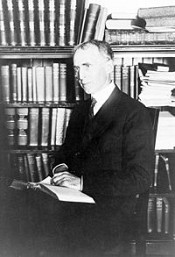
Charles Austin Beard (November 27, 1874 – September 1, 1948) was an American historian. He published hundreds of monographs, textbooks and interpretive studies in both history and political science. His works included radical re-evaluation of the Founding Fathers of the United States, who he believed were more motivated by economics than by philosophical principles. As a leader of the "progressive historians," or "progressive historiography," he introduced themes of economic self-interest and economic conflict regarding the adoption of the Constitution and the transformations caused by the Civil War. Thus he emphasized the long-term conflict among industrialists in the Northeast, farmers in the Midwest, and planters in the South that he saw as the cause of the Civil War. His study of the financial interests of the drafters of the United States Constitution (An Economic Interpretation of the Constitution) seemed radical in 1913, since he proposed that the U.S. Constitution was a product of economically determinist, land-holding founding fathers. He saw ideology as a product of economic interests. Beard's most influential book was the wide-ranging and bestselling The Rise of American Civilization (1927) and its two sequels, America in Midpassage (1939), and The American Spirit (1943), written with his wife, Mary. Historian Carl Becker in History of Political Parties in the Province of New York, 1760-1776 (1909) formulated the Progressive interpretation of the American Revolution. He said there were two revolutions: one against Britain to obtain home rule, and the other to determine who should rule at home. Beard expanded upon Becker's thesis, in terms of class conflict, in An Economic Interpretation of the Constitution of the United States (1913) and An Economic Interpretation of Jeffersonian Democracy (1915). To Beard, the Constitution was a counter-revolution, set up by rich bondholders (personalty; bonds were "personal property"), in opposition to the farmers and planters (realty; land was "real property.") Beard argued the Constitution was designed to reverse the radical democratic tendencies unleashed by the Revolution among the common people, especially farmers and debtors. In 1800, said Beard, the farmers and debtors, led by plantation slave owners, overthrew the capitalists and established Jeffersonian democracy. Other historians supported the class-conflict interpretation, noting the states confiscated great semi-feudal landholdings of loyalists and gave them out in small parcels to ordinary farmers. Conservatives, such as William Howard Taft, were shocked at the Progressive interpretation because it seemed to belittle the Constitution.[1] Many scholars, however, eventually adopted Beard's thesis and by 1950 it had become the standard interpretation of the era. Beginning about 1950, however, historians started to argue that the progressive interpretation was factually incorrect.[2]Template:Clarify source Forrest McDonald in We The People: The Economic Origins of the Constitution (1958) argued that Charles Beard had misinterpreted the economic interests involved in writing the Constitution. Instead of two interests, landed and mercantile, which conflicted, there were three dozen identifiable interests that forced the delegates to bargain. Controversy raged, but by 1970 the Progressive interpretation of the era was dead. It was largely replaced by the intellectual history approach, which stressed the power of ideas, especially republicanism, in stimulating the Revolution.[3] However, the legacy of examining the economic interests of American historical actors remains enduring. Dealing with Reconstruction and the Gilded Age, disciples of Beard such as Howard Beale and C. Vann Woodward focused on greed and economic causation and emphasized the centrality of corruption. They argued that the rhetoric of equal rights was a smokescreen hiding their true motivation, which was promoting the interests of industrialists in the Northeast. The basic flaw was the assumption that there was a unified business policy. Scholars in the 1950s and 1960s demonstrated that businessmen were widely divergent on monetary or tariff policy. While Pennsylvania businessmen wanted high tariffs, those in other states did not; the railroads were hurt by the tariffs on steel, which they purchased in large quantity.[4] Beard's economic approach lost influence in the history profession after 1950 as conservative scholars suggested serious flaws in Beard's research, and attention turned away from economic causation.[5] Beard's interest in progressive higher education was an early one. In 1899, he collaborated with Walter Vrooman at Oxford in the founding of Ruskin Hall, which was billed as an accessible school for the working man. In exchange for considerable reduction in tuition, students worked in the school's various businesses. After resigning from Columbia University in protest in 1917, he helped to found the New School for Social Research in New York, and advised on reconstructing Tokyo after the earthquake of 1923. Although enormously influential through his massive writings, he did not have graduate students or build a school of historiography. Beard attended and graduated from DePauw University in 1898. It was at DePauw that he met Mary Ritter. They later were married. Many of his books were written in collaboration with his wife, whose own interests lay in feminism and the labor union movement (Woman as a Force in History, 1946). Together they wrote a popular survey, The Beards: Basic History of the United States. Starting as a leading liberal supporter of the New Deal, Beard turned against Franklin Delano Roosevelt's foreign policy. Beard promoted "American Continentalism," arguing that the United States had no vital stake in Europe and that a foreign war would threaten dictatorship at home. Beard was thus one of the leading proponents of American non-interventionism. After the war, Beard's last work, President Roosevelt and the Coming of the War (1948), blamed Roosevelt for lying to the American people and tricking them into war. It generated angry controversy as internationalists denounced Beard as an apologist for isolationism. As a result, Beard's reputation collapsed among liberal historians who previously had admired him. His whole interpretation of history came under widespread attack, though a few leading historians such as Beale and Woodward clung to the Beardian interpretation of American history. Recently, however, Beard's isolationist approach, especially his advocacy of a non-interventionist foreign policy, has enjoyed something of a comeback. Andrew Bacevich, a historian of diplomacy from Boston University, has used Beard's skepticism towards armed intervention overseas as a starting point for his own critique of post-Cold-War American foreign policy; Beard is heavily cited in Bacevich's analysis of this policy, American Empire. In addition, Beard's foreign policy views have become popular with supporters of paleoconservatism, such as Pat Buchanan. Beard's stress on economic causation influenced the "Wisconsin school" of New Left, or revisionist, historians William Appleman Williams, Gabriel Kolko, and James Weinstein. In the field of political science, Beard was active in the American Political Science Association and was elected its President in 1926.[6] He was also a member of the American Historical Association and served as its president in 1933.[7] He was best known for his studies of the Constitution, and for his creation of bureaus of municipal research and his studies of public administration in cities, including a famous study of Tokyo, The Administration and Politics of Tokyo, (1923). A White · Bancroft · Winsor · Poole · CK Adams · Jay · Henry · Angell · H Adams · Hoar · Storrs · Schouler · Fisher · Rhodes · Eggleston · CF Adams · Mahan · Lea · Smith · McMaster · Baldwin · Jameson · G Adams · Hart · Turner · Sloane · Roosevelt · Dunning · McLaughlin · Stephens · Burr · Ford · Thayer · Channing · Jusserand · Haskins · Cheyney · Wilson · Andrews · Munro · Taylor · Breasted · Robinson · Greene · Becker · Bolton · Beard · Dodd · Rostovtzeff · McIlwain · Ford · Larson · Ferguson · Farrand · Thompson · Schlesinger · Neilson · Westermann · Hayes · Fay · Wertenbaker · Latourette · Read · Morison · Schuyler · Randall · Gottschalk · Curti · Thorndike · Perkins · Langer · Webb · Nevins · Bemis · Bridenbaugh · Brinton · Boyd · Lane · Nichols · Holborn · Fairbank · Woodward · Palmer · Potter · Cochran · L White · Hanke · Wright · Morris · Gibson · Bouwsma · Franklin · Pinkney · Bailyn · Craig · Curtin · Link · McNeill · Degler · Davis · Iriye · Harlan · Herlihy · Leuchtenburg · Wakeman · Tilly · Holt · Coatsworth · Bynum · Appleby · Miller · Darnton · Foner · Louis · Hunt · McPherson · Spence · Sheehan · Kerber · Weinstein · Spiegel



















readers also enjoyed
Do you want to exchange books? It’s EASY!
Get registered and find other users who want to give their favourite books to good hands!

